
Are You Making These 5 Common Small Business Marketing Mistakes? (And How to Fix Them for Under $500) (2026 Edition)
- Shalena Ward

- Dec 25, 2025
- 5 min read
Look, we've all been there. You're scrolling through social media at 11 PM, watching some entrepreneur brag about their "seven-figure launch," and you're wondering why your marketing feels like shouting into the void. Your website's getting some traffic, you're posting content, maybe even running some ads, but the phone's not exactly ringing off the hook.
Here's the thing: most small businesses aren't failing because they don't have a massive marketing budget. They're failing because they're making the same five mistakes over and over again. The good news? These mistakes are totally fixable, and you don't need to blow your savings to do it.
I'm talking real fixes that cost less than $500 total, not some guru's $5,000 "transformation package." Let's dive into what's probably going wrong and how to fix it without breaking the bank.
Mistake #1: Pumping Out Content Like a Content Farm (Instead of Creating Stuff People Actually Want)
You've probably heard it a million times: "Content is king!" So you started cranking out blog posts, social media updates, and videos like your business depends on it. Plot twist, it might be hurting you.
Here's what's happening: AI tools made it super easy to generate tons of content, so everyone's doing it. The problem? Most of it's generic, boring, and doesn't actually help anyone. You're competing in a sea of "Top 10 Tips" posts that all say the same thing.
The Real Cost: You're spending hours every week creating content that gets ignored, while your competitors who create less (but better) content are getting all the attention and customers.
The Fix (Cost: $0-50/month):
Stop the content hamster wheel. Instead of posting five mediocre pieces a week, create one killer piece every two weeks. Use free tools like Google Trends or Answer the Public to see what your customers are actually searching for. Then write something that genuinely helps them solve a specific problem.
For example, instead of "10 Marketing Tips for Small Business," write "How I Got My First 50 Customers Using Only Free Instagram Tools (Step-by-Step Guide)." See the difference? One's generic; the other makes people think, "I need to read this right now."

Mistake #2: Treating Your Google Business Profile Like a "Set It and Forget It" Tool
Your Google Business Profile is basically your storefront for local customers. But most small businesses set it up once and then... crickets. Meanwhile, your competition is actively managing theirs and stealing your customers.
The Real Cost: Local customers can't find you when they search for businesses like yours. Even worse, when they do find you, your outdated info makes you look unprofessional or even closed.
The Fix (Cost: $0):
This one's completely free but requires some weekly love. Here's your action plan:
Post weekly updates about what's happening in your business (new services, behind-the-scenes content, customer wins)
Upload fresh photos every month, customers want to see what your place actually looks like
Respond to every review within 24 hours (yes, even the bad ones)
Make sure your business hours are always current
Add relevant categories and services
Spend 30 minutes every Monday morning updating your profile. It's free marketing that actually works because Google loves active profiles and shows them higher in local search results.
Mistake #3: Running Ads Without Knowing What's Actually Working
This one makes me cringe every time. You're spending money on Google Ads or Facebook ads, getting excited about clicks and impressions, but you have no idea if those clicks are turning into customers. It's like driving with a blindfold on.
The Real Cost: You're literally throwing money away on ads that might not be working, while potentially turning off ads that are actually bringing in customers.
The Fix (Cost: $0-100 for testing):
Set up conversion tracking immediately. I don't care if you're not "technical": this is too important to ignore.
For Google Ads, connect Google Analytics 4 (free) and track what actually matters: phone calls, form submissions, purchases, whatever action means "customer" to your business.
For Facebook/Instagram ads, set up the Meta pixel. It sounds scary, but there are literally thousands of YouTube videos showing exactly how to do it.
Once you have tracking set up, start with a small test budget: $100 max. Run one simple ad campaign and watch what happens. Don't get excited about clicks or reach. Only care about actual conversions.
Mistake #4: Making Your Customers Jump Through Hoops to Give You Money
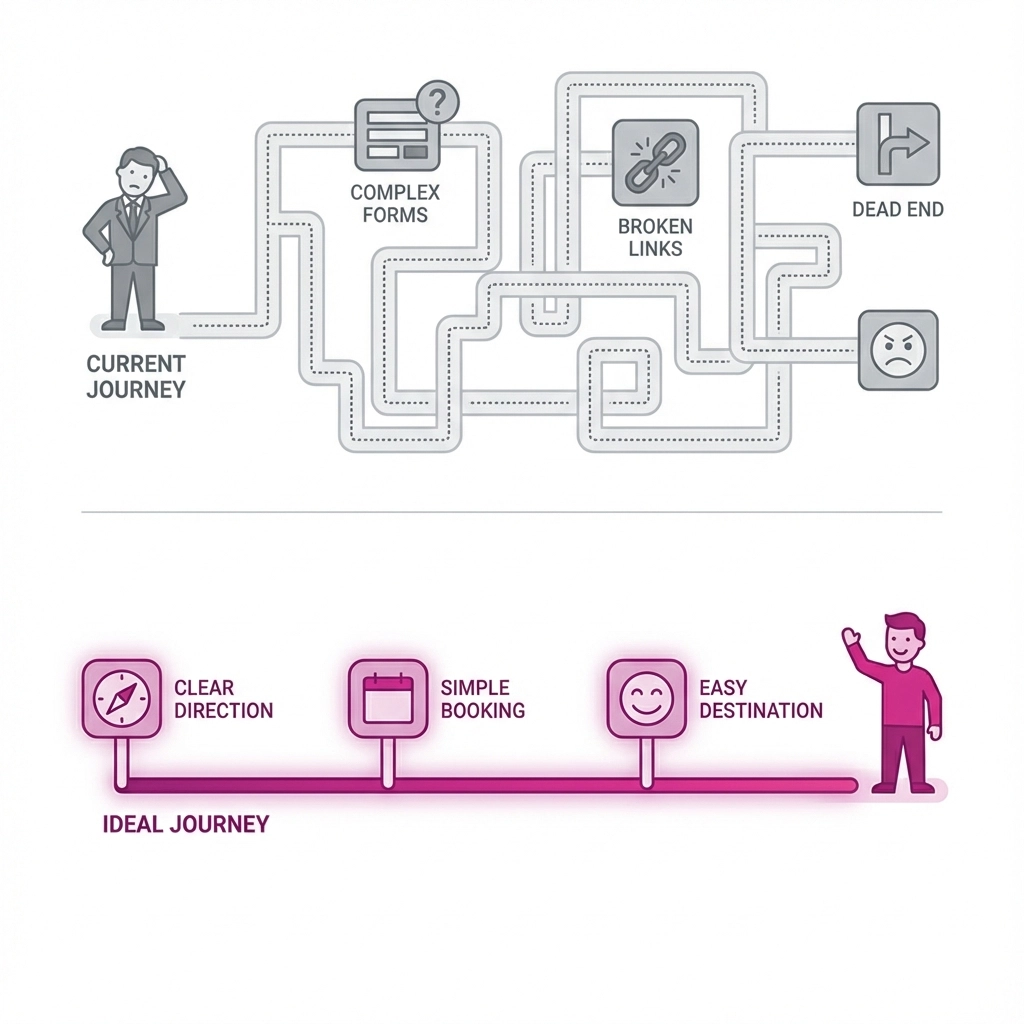
This one's painful because it's so avoidable. You've done the hard work of getting someone interested in your business, but then your booking process is a nightmare, your pricing is hidden, or it takes three emails just to schedule a call.
Every extra step you make customers take is a chance for them to change their mind and go with someone else.
The Real Cost: You're losing customers right at the finish line. It's like training for a marathon and then tripping 10 feet from the end.
The Fix (Cost: $0-50/month):
Audit every touchpoint where customers interact with your business. Ask yourself: "Is this easy, or am I making them work?"
Here's your friction-elimination checklist:
Set up online booking (Calendly's free plan works great for most businesses)
Put your pricing somewhere obvious (even if it's just "starting at $X")
Create a clear contact form that doesn't ask for their life story
Set up an auto-reply email so they know you got their message
Make sure your phone number is clickable on mobile
Test your own customer experience. Try booking your own services or buying your own products. If it feels annoying to you, imagine how it feels to a potential customer who doesn't know you yet.
Mistake #5: Playing All Your Marketing Cards on One Platform
Instagram's working great, so you put all your energy there. Or maybe Google Ads is bringing in customers, so that's your whole strategy. Then the algorithm changes, or costs go up, and suddenly your business is in trouble.
The Real Cost: You're one platform change away from losing your main customer source. Plus, you're missing out on customers who hang out on other platforms.
The Fix (Cost: $100-200 for testing):
Diversify without spreading yourself too thin. Pick 2-3 channels max and do them well. Here's a simple approach:
One free channel (Google Business Profile, organic social media, or email list)
One low-cost paid channel (start with $50-100/month)
One relationship-building channel (networking, partnerships, or referrals)
Don't try to be everywhere at once. Master one channel, then add another. And always, always have a way to own the relationship: like an email list: so you're not completely dependent on any platform.
Also, nail down your value proposition. If someone asks what you do and why they should care, you should be able to answer in one clear sentence. "We help busy parents meal prep healthy dinners in under 30 minutes" beats "We're a nutrition consulting company" every single time.
The Bottom Line: Strategy Beats Spending
Here's what I've learned after working with hundreds of small businesses: the ones that succeed aren't necessarily the ones with the biggest budgets. They're the ones that understand their customers, remove friction, and focus on what actually drives results instead of what looks impressive in a report.
These five fixes won't cost you a fortune, but they will cost you some time and honest self-evaluation. The question is: are you ready to stop making the same mistakes and start getting real results?
Want help implementing any of these fixes? Check out our services or shoot us a message. We've helped dozens of small businesses turn their marketing around without blowing their budgets: and we'd love to help you do the same.
Comments